This weeks Something for the Weekend is 'Le Freak' by Niles Rogers.
Legendary producer and co-founder of Chic, Nile Rodgers wrote 'We Are Family' for Sister Sledge and 'I'm Coming Out' for Diana Ross before producing Let's Dance for David Bowie and Like a Virgin for Madonna. But before he reinvented pop music, Nile Rodgers invented himself. Le Freak is the personal, moving story of a creative genius. It is also a stunning recreation of an age - told by the man who wrote its soundtrack.
''This has to be one of the best autobiographies I've read this year. From his upbringing,with his drug fuelled relatives,and how he managed to strive & work hard to get himself out of it - to becoming one of the most sort after producers/musicians of our time. Once you read a few pages,you will not be able to put it down''.
Matthew
Buy it here or find it on our Staff choice display in store.
Friday, 17 August 2012
Friday, 10 August 2012
Something For The Weekend: The Smoking Diaries
Something For The Weekend: The Smoking Diaries by Simon Gray
As the Olympics draw to a close this weekend it seems fitting to recommend something thoroughly un-Olympian. Not that the Olympics haven't been great, you'll get no complaints here, it's just that you can have too much of a good thing and I'm beginning to feel a little sported-out. So, The Smoking Diaries by Simon Gray.
Olympian is not a word you would immediately associate with Gray (though he was a cricket lover all his life and talented athlete in his youth) and it would be fair to say that The Smoking Diaries is a sedantary book. For the most part Gray is sitting at his desk late into the night thinking about his life. Sometimes he is on holiday sitting at a table overlooking the sea late into the night thinking about his life. At all times he is smoking or about to light another cigarette.
It is not, however, the smoking that makes this book anti-Olympian. For the record neither I, nor Blackwell's recommend smoking. Simon Gray doesn't recommend smoking. The book isn't about smoking, it just happens to be what Simon Gray is doing while he writes his diary each night. What makes the book anti-Olympian is that it's about the whole of a life not just a crowning moment, and it's success is no less spectacular than Usain Bolt's.
Gray looks clearly and unsentimentally at the things he has done. There are the long years of alcoholism, the affairs, the hurt he has brought upon others and himself. Then there are the good things: the plays, the successful second marriage, the friendships. How all of it fits together now that he is on his way out is what concerns him. The ways in which his increasing, and increasingly terrifying sense of mortality colours everything that has happened in his life obsesses Gray. He sits up late into the night thinking about it all, trying to puzzle it out, distracting himself with memories of family, lost friends, personal and professional successes and catastrophes.
It calls itself a diary, but while we never doubt that Gray keeps a diary, we know we are not reading it. There is a rough chronology of events taking place in his life on which the book depends for momentum, but the glory of it comes in the places he drifts off to from these events. What we are reading are the things that go through Gray's mind while he is writing his diary. They are the things that he couldn't put in a normal diary because the diary would end up as a book: The Smoking Diaries.
In tone and pace it reads like a mind talking to itself about death. It is admittedly an unusually wise, hyper-articulate, funny and honest mind, but it is recognisably human, unlike, say, running 10 metres in less than a second, then doing it again another 19 times in a row.
As the Olympics draw to a close this weekend it seems fitting to recommend something thoroughly un-Olympian. Not that the Olympics haven't been great, you'll get no complaints here, it's just that you can have too much of a good thing and I'm beginning to feel a little sported-out. So, The Smoking Diaries by Simon Gray.
Olympian is not a word you would immediately associate with Gray (though he was a cricket lover all his life and talented athlete in his youth) and it would be fair to say that The Smoking Diaries is a sedantary book. For the most part Gray is sitting at his desk late into the night thinking about his life. Sometimes he is on holiday sitting at a table overlooking the sea late into the night thinking about his life. At all times he is smoking or about to light another cigarette.
It is not, however, the smoking that makes this book anti-Olympian. For the record neither I, nor Blackwell's recommend smoking. Simon Gray doesn't recommend smoking. The book isn't about smoking, it just happens to be what Simon Gray is doing while he writes his diary each night. What makes the book anti-Olympian is that it's about the whole of a life not just a crowning moment, and it's success is no less spectacular than Usain Bolt's.
Gray looks clearly and unsentimentally at the things he has done. There are the long years of alcoholism, the affairs, the hurt he has brought upon others and himself. Then there are the good things: the plays, the successful second marriage, the friendships. How all of it fits together now that he is on his way out is what concerns him. The ways in which his increasing, and increasingly terrifying sense of mortality colours everything that has happened in his life obsesses Gray. He sits up late into the night thinking about it all, trying to puzzle it out, distracting himself with memories of family, lost friends, personal and professional successes and catastrophes.
It calls itself a diary, but while we never doubt that Gray keeps a diary, we know we are not reading it. There is a rough chronology of events taking place in his life on which the book depends for momentum, but the glory of it comes in the places he drifts off to from these events. What we are reading are the things that go through Gray's mind while he is writing his diary. They are the things that he couldn't put in a normal diary because the diary would end up as a book: The Smoking Diaries.
In tone and pace it reads like a mind talking to itself about death. It is admittedly an unusually wise, hyper-articulate, funny and honest mind, but it is recognisably human, unlike, say, running 10 metres in less than a second, then doing it again another 19 times in a row.
Friday, 3 August 2012
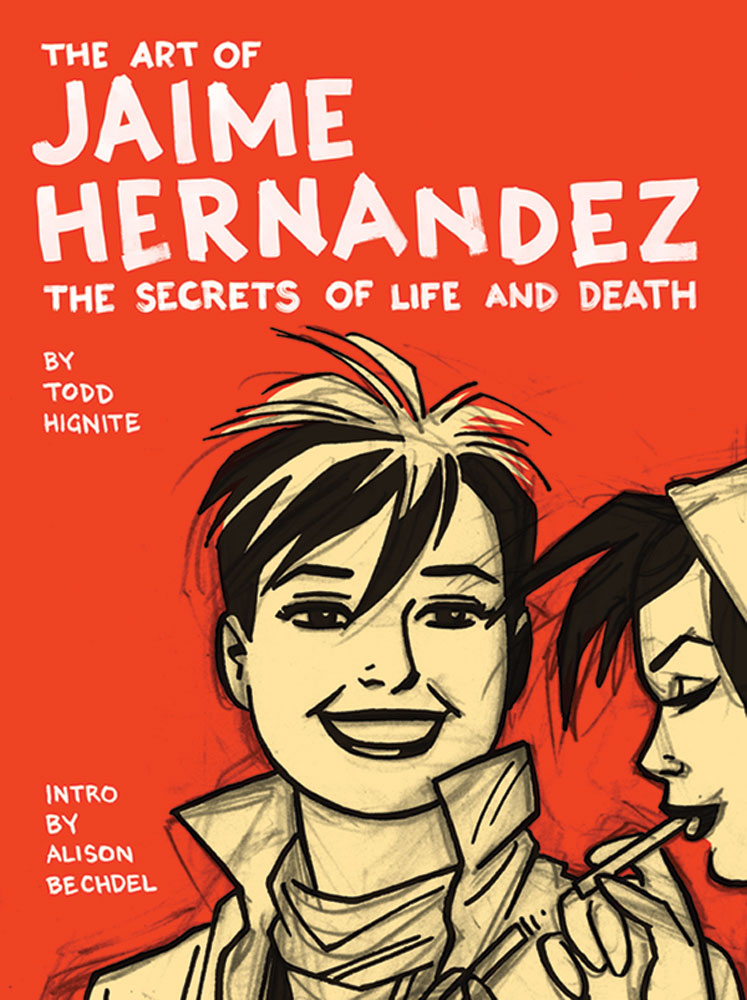
Something for the Weekend.. The Art of Jaime Hernandez.
The Art of Jaime Hernandez.
First published in 1981 "Love and Rockets" is one of the most influential comics ever published, redefining what it is possible for graphic fiction to achieve. Jaime Hernandez's Locas stories have been the backbone of the comic since its inception. Starting as the story of a group of teenagers in the early years of the California punk scene, over the past 30 years the characters have aged in real time leading to a depth of character unheard of most fiction.
For the first time in "The Art of Jaime Hernandez" the author has opened his archive, revealing never before seen sketch's and artwork. Accompanying the art are in depth interviews with Hernandez, where he discusses the inspiration behind the characters who have populated "Love and Rockets" for the past 30 years.
A fascinating insight into the work of one of the greats of modern literature. Alan Moore has said "Jaime's art balances big white and black spaces to create a world of nuance in between, just as his writing balances our big human feelings and our small human trivias to generate its incredible emotional power. Quite simply, this is one of the twentieth century's most significant comic creators at the peak of his form, with every line a wedding of classicism and cool." and as Pop Will Eat Itself told us many years ago Alan Moore knows the score.
Friday, 27 July 2012
Something For The Weekend... Yoga For People Who Can't Be Bothered To Do It
Whatever one feels about the Olympics (for the record I'm quite excited) I think we all know that travelling around is going to be a bit of a nightmare. I would recommend you stay at home but then you won't come to the shop so I won't do that. Instead I will give you something to distract you from all the delays and discomforts. I read it standing in the vestibule of a train travelling from Birmingham to Edinburgh. Actually I read most of it standing in the vestibule of a train not travelling from Birmingham to Edinburgh- I remember one particularly lengthy stop in a field not far from Preston, followed by a couple of hours at Preston Station. It was storms rather than sport which did for that journey but Yoga For People Who Can't Be Bothered To Do It got me through with nothing worse than some odd looks when I dribbled a bit from laughing. It will make your journey better.
So the first thing to say is that it is very very funny. I'm not exactly sure why it's so funny, there are some excellent set pieces but it's not these that mark it out particularly, it's more to do with the tone in which Dyer tells his tales of travel, love, and disaster. I think of it as a book which can't quite make up it's mind about what it is, and the tone reflects this. It resembles a travel memoir- and it is this- but it is also something else: it's a sort of attempt to find coherence from a motley selection of memories. As the pieces progress it becomes clear that for Dyer this motley collection of memories already possess an uncanny coherence, he's just trying to figure out why.
Miraculously, the fact that Dyer doesn't seem entirely sure what is going on does not make it difficult to read. By all rights it should be awful. Essentially what we have is a guy we don't know telling us about the time he took lots of drugs, had lots of sex and visited lots of beautiful and amazing places with beautiful and amazing people. It should be like sitting through the endless holiday snaps of some smug friend-of-a-friend just back from Interailing, but it isn't. A lot of the time the drugs have turned on him, the girl has left him and he's lost. Even when he's blissfully happy and content he know's he's not really; or the older Dyer, the one writing the book, knows he's not really, or that he won't be for much longer. But here again the book eludes us because this sounds sad, is sad, and is also funny. When I wrote that much of the humour lies in the tone I meant that it lies in the gap between the man who had the fun and the man writing about the fun. Sometimes this gap is huge and ironic, then at other times you can almost feel Dyer willing himself back to this beach party or that cafe: it's moving, pathetic, honest and very funny.
By the end of the book Dyer has been from New Orleans to Libya to Cambodia, he's met lots of people, lost contact with just as many, and he's still not certain what is going on, but he does have a better sense of his life and his relationship to his memories. And your nightmarish journey will be over without you noticing it had started.
Monday, 23 July 2012
Latitude Festival 2012
The non-fiction talks also did really well, with subjects ranging from beekeeping to Bruce Springsteen; from migraines to politics with John Pilger; and from last year's riots to brains. All in all the weekend was a success and we hope to do the book sales for Latitude for many years to come.
Friday, 20 July 2012
Something for the weekend.. Soccernomics
Something a little different this week - it's Soccernomics by Simon Kuper & Stefan Stymanzki.
After claiming a few weeks back that you didn't have to like Football to enjoy 'The Damned Utd' I can safely say the opposite about this title. Having said that, if you do love your footy you will absolutely love this book (& it's a perfect present for the scarf waver in the family).
There are a lot of statistics in this book - this can't be denied, but somehow it's far from a 'dry' read. One reason for this is Kuper's writing style, he's a wry, amusing man who keeps the information interesting by peppering it with witty remarks & sometimes amusingly (almost) bitchy comments. The other is that the statistics themselves are so very interesting. We discover why England are in fact over achieving each time we get knocked out in the quarter finals, yes over achieving. You may scoff but by the time Kuper has run through the reasons you'll be stifling a sob for our plucky heroes!
Another cracking chapter involves the 'science' of penalties, for example the reason Anelka missed that champions league effort was that he was the only one who ignored the advice of the statisticians (Terry was trying to follow instructions when he slipped - he's never to blame ay?).
You'll also discover why it doesn't really matter who your manager is (most of the time), and is Football racist? (nothing to do with high court cases but looking at transfers). It's fascinating, entertaining stuff.
I would also recommend you take a look at 'The Football Men' a collection of Kuper's articles on some of the legends & lesser (but no less interesting) lights of the beautiful game.
But it here
Gary
After claiming a few weeks back that you didn't have to like Football to enjoy 'The Damned Utd' I can safely say the opposite about this title. Having said that, if you do love your footy you will absolutely love this book (& it's a perfect present for the scarf waver in the family).
There are a lot of statistics in this book - this can't be denied, but somehow it's far from a 'dry' read. One reason for this is Kuper's writing style, he's a wry, amusing man who keeps the information interesting by peppering it with witty remarks & sometimes amusingly (almost) bitchy comments. The other is that the statistics themselves are so very interesting. We discover why England are in fact over achieving each time we get knocked out in the quarter finals, yes over achieving. You may scoff but by the time Kuper has run through the reasons you'll be stifling a sob for our plucky heroes!
Another cracking chapter involves the 'science' of penalties, for example the reason Anelka missed that champions league effort was that he was the only one who ignored the advice of the statisticians (Terry was trying to follow instructions when he slipped - he's never to blame ay?).
You'll also discover why it doesn't really matter who your manager is (most of the time), and is Football racist? (nothing to do with high court cases but looking at transfers). It's fascinating, entertaining stuff.
I would also recommend you take a look at 'The Football Men' a collection of Kuper's articles on some of the legends & lesser (but no less interesting) lights of the beautiful game.
But it here
Gary
Friday, 13 July 2012
Something for the weekend.. Smut
This weeks Something for the weekend is 'Smut' by Alan Bennett.
Here Bennett goes behind the twitching curtains in two novellas that both, in their own way, deal with sex, repression & to some degree class. The first story deals with Mrs Donaldson, she finds herself widowed & in need of a little extra money so takes in lodgers. When the student pair are short one month they offer Mrs Donaldson a 'private show' in lieu of payment, opening up new possibilities to the previously homely Mrs Donaldson. I love Bennett's characters, he can produce well rounded believable characters with just a few sharp lines.
There's a lot of talk of sex in literature at the moment isn't there? '50 shades..' is everywhere, but I didn't have that, or that in mind when I picked up 'Smut'.
I've always like Alan Bennett's work, whether it be his autobiographical books, his plays & scripts,or his fiction. A particular favourite is his hilarious yet touching script for 'Prick up your ears' his adaptation for film of John Lahr's Joe Orton biography & indeed, reading Smut, I felt that had Orton been allowed to grow old disgracefully then 'Smut' would have been the sort of work he himself may have produced. It's that delightful, snappy, 'outrageous' dialogue - the oft-repeated question answered with a question that reminds me of prime Orton.
The second story involves the preening, self absorbed, secretly homosexual Graham. He takes a wife as he thinks he should but his extra marital affairs lead him into danger, meanwhile all is not as it seems with his new 'plain' wife or his seemingly hen-pecked Father. This story is really all about secrets & lies. Every character's secret inner life being shielded from the other leading to complications that could have easily been avoided. Graham's Mother is a particuarly grand Bennett creation.
Beautifully written, with his trademark wit & biting dialogue this is genuinely a weekend read - I read it in a matter of hours. If you enjoyed the BBC talking heads shows then do have a look at this. It's very easy to imagine (for example) Patricia Routledge or Prunella Scales sat in a cosy armchair telling the first tale with a secret smile & darting eyes. I'd also recommend The Uncommon Reader , Bennett's tale of the Queens literary awakening as another quick but satisfying read.
Gary
Subscribe to:
Posts (Atom)